
Raman spectroscopy is an analytical technique used to identify the molecular structure of a material based on the interaction between laser light and the sample. This technique utilizes the phenomenon of inelastic light scattering, in which a small portion of the incident light undergoes an energy change as a result of interactions with molecular vibrations.
These energy shifts produce characteristic spectral patterns for each compound, making Raman spectra often referred to as a "molecular fingerprint." The fundamental concept was discovered by the Indian physicist C. V. Raman, who was awarded the Nobel Prize in Physics in 1930 for the discovery of the Raman Effect.
Working Principle

When a laser beam is directed onto a sample:
- Most of the scattered light undergoes Rayleigh scattering (no change in energy).
- A small fraction undergoes Raman scattering (with an energy shift).
These energy changes are directly related to molecular bond vibrations, resulting in a unique spectrum for each material.
Raman Instrumentation
The main components of a Raman spectroscopy system include:
- A laser as the excitation light source
- A sample stage for positioning the sample
- A spectrometer for separating scattered light according to wavelength
- A CCD detector for capturing Raman signals
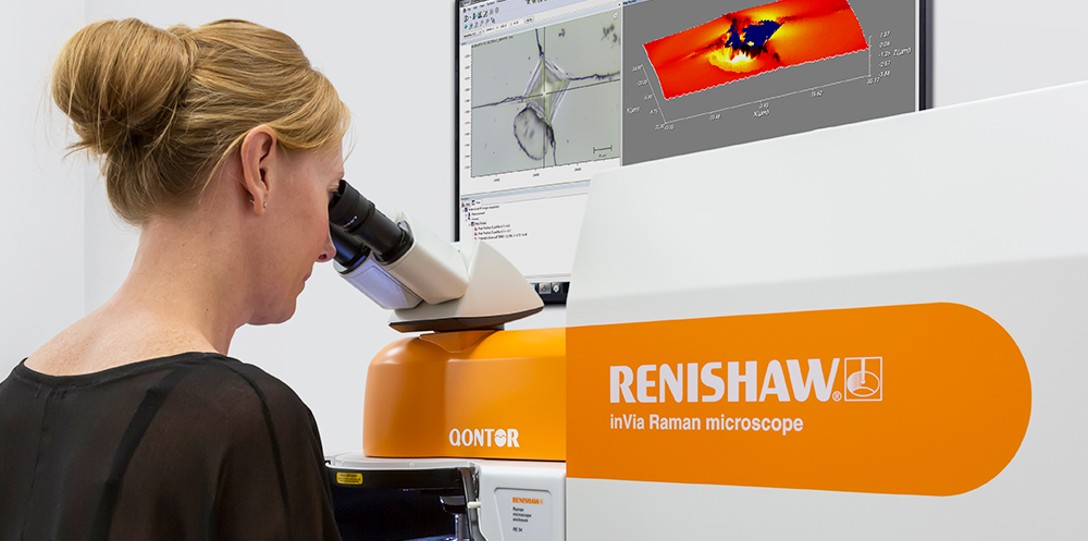
One of the Raman systems widely used in both research and industry is the Renishaw inVia Raman Microscope.
Advantages of Raman Spectroscopy
- Non-destructive analysis
- Minimal or no sample preparation required
- Applicable to solids, liquids, and gases
- Capable of analyzing samples through certain transparent containers such as glass or plastic
Limitations

- Raman signals are inherently weak compared to Rayleigh scattering
- Measurements can be affected by sample fluorescence
- Proper laser wavelength selection is required (e.g., 785 nm or 1064 nm) to minimize fluorescence interference
Applications of Raman Spectroscopy

Raman spectroscopy is widely used across various fields, including:
- Materials Science – analysis of polymers, composites, and graphene
- Pharmaceuticals – identification of active pharmaceutical ingredients (APIs)
- Biomedical Research – analysis of cells and tissues
- Forensic Science – identification of chemical substances and residues
- Carbon Materials Industry – characterization of graphene, carbon nanotubes, and other carbon-based materials
References
- Ferraro, J. R., Nakamoto, K., & Brown, C. W. (2003). Introductory Raman Spectroscopy. Academic Press.
- Smith, E., & Dent, G. (2019). Modern Raman Spectroscopy: A Practical Approach. Wiley.
- Long, D. A. (2002). The Raman Effect: A Unified Treatment of the Theory of Raman Scattering. Wiley.
- McCreery, R. L. (2000). Raman Spectroscopy for Chemical Analysis. Wiley-Interscience.
- Nobel Prize. (1930). C. V. Raman – Nobel Lecture.